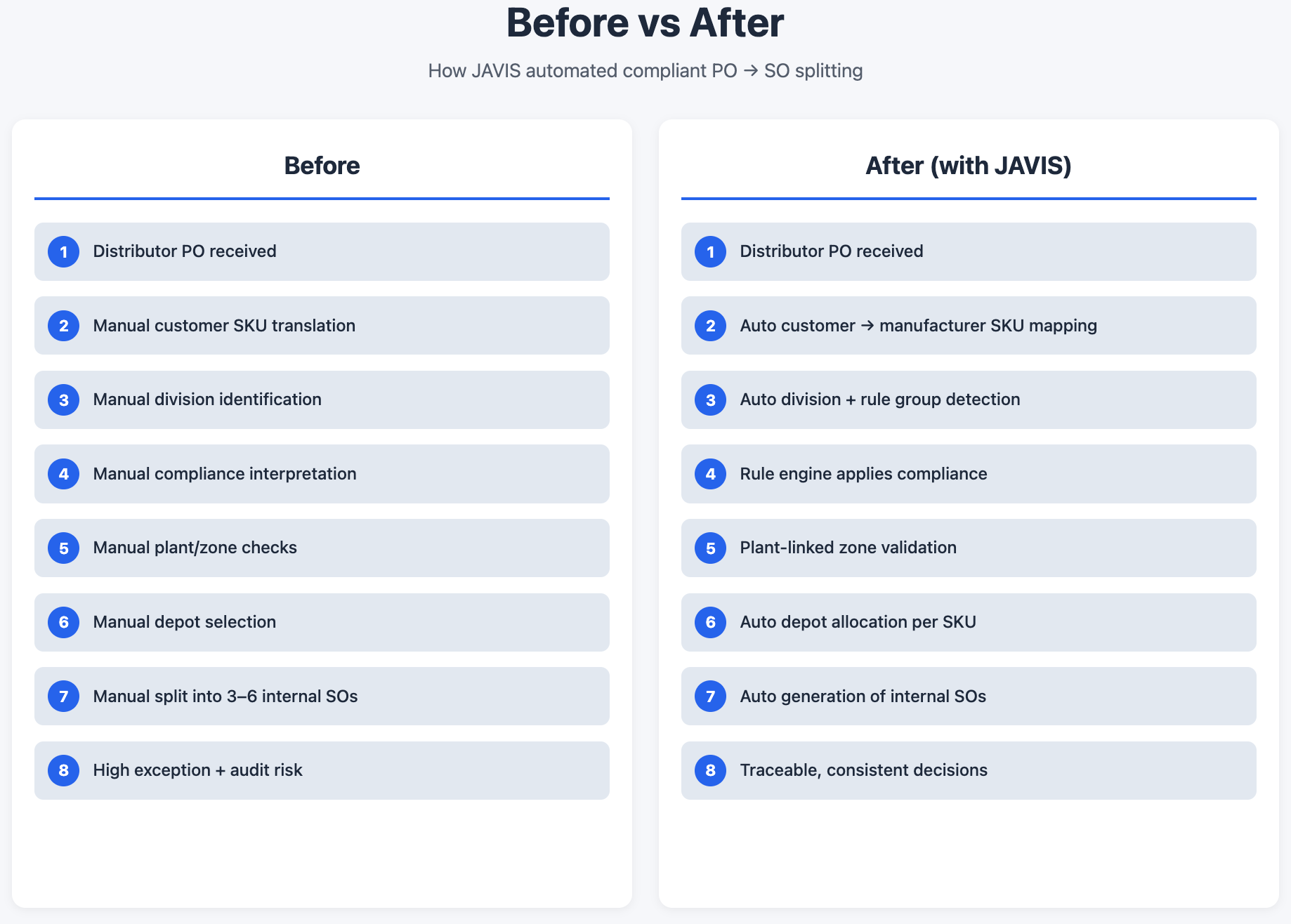
A configuration-driven rules engine that automated compliant splitting and routing for a 25,000-SKU FMCG network
At A Glance:
-
Industry: FMCG (India-wide distribution)
-
Scale: 25,000+ SKUs across food, personal care, pest control, cigarettes, matches, and incense sticks
-
Core constraint: One distributor PO often contained products governed by different licensing and storage regimes (FSSAI, COTPA, Insecticides Act, hazardous storage norms)
-
Operational symptom: One distributor PO regularly required 3–6 internal sales orders, created through manual interpretation and splitting
-
Business outcome: Full compliance routing, faster order clearance, and a scalable foundation for new categories, without relying on heroics.
The Opportunity
For large Indian FMCG enterprises, distribution excellence isn’t only about coverage, it’s about how reliably you can translate commercial demand into compliant execution.
This client’s distributors placed consolidated purchase orders (POs). The problem: those POs routinely mixed products that cannot legally be stored or routed together. Food items governed by FSSAI cannot share storage with tobacco SKUs regulated under COTPA; pest-control products fall under the Insecticides Act and require distinct storage handling. What looked like a single PO on paper was, operationally, a set of different fulfillment and compliance pathways.
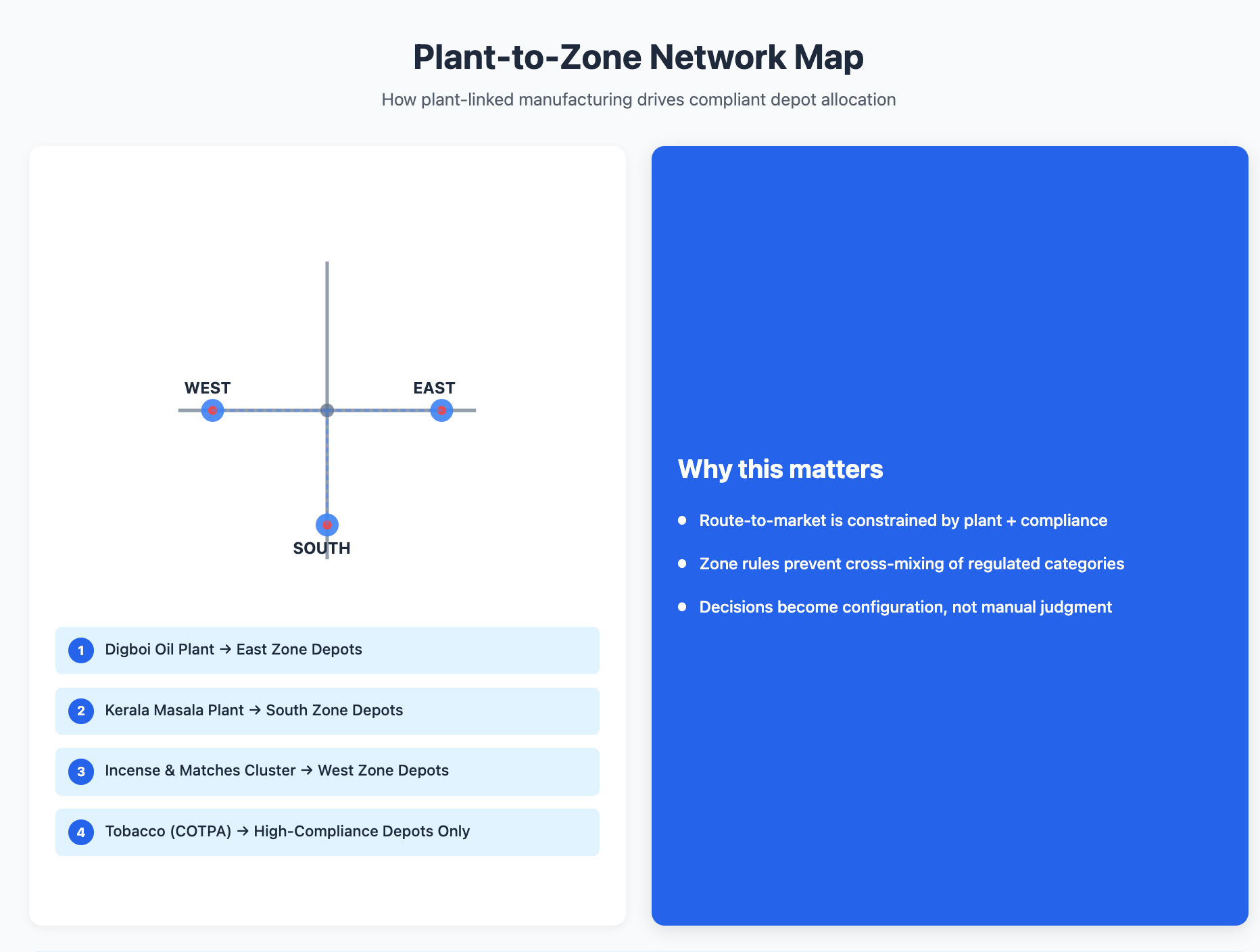
At the same time, the client’s network design was not “one warehouse serves all.” Several categories were plant-linked and zone-constrained: oils produced in Digboi flowed into East depots; Kerala plant masala blends fed South depots; incense sticks and matches were centralised in the West due to vendor proximity. Tobacco products were restricted to high-compliance depots.
The stakes were clear: each incorrect depot decision was not just an operational error, it carried regulatory exposure and reputational risk. Yet even with modern ERP and WMS, depot assignment still depended on human interpretation because the underlying rule complexity lived outside the system.
The Challenge
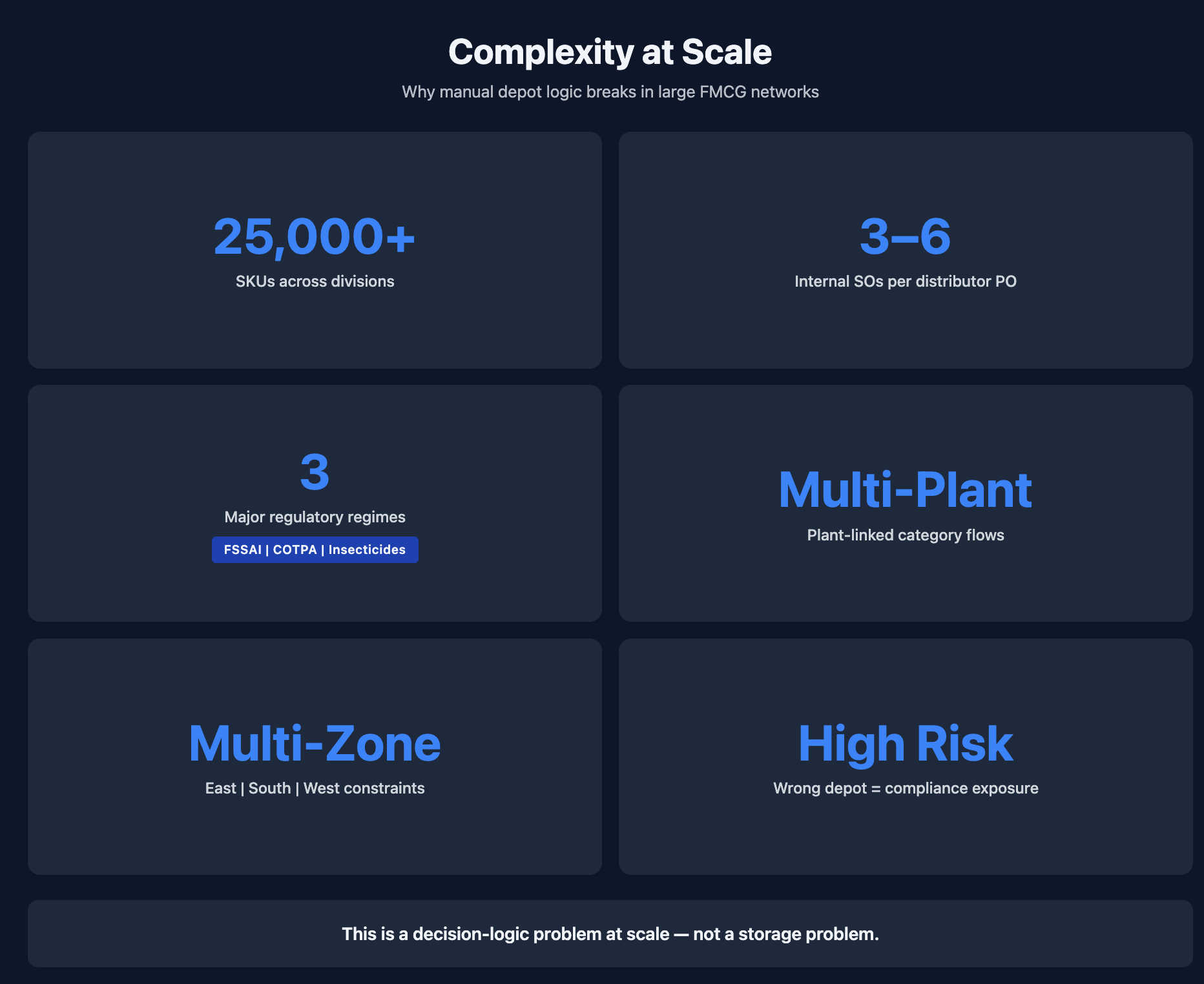
The client didn’t have a storage problem. They had a decision-logic problem, and it was scaling faster than people could manage.
A typical distributor PO could include SKUs tied to different laws, plants, and zones. To route such a PO correctly, teams had to manually reconcile:
- Licensing and storage rules (what can or cannot co-exist)
- Depot eligibility (which depots are licensed to store which product groups)
- Plant-linked and zone constraints (which depots should serve which flows)
The operating consequences showed up in five recurring pain points:
-
No central system linking licensing rules to depot eligibility
-
Customer/distributor SKU codes differed from internal codes; translation was manual and error-prone
-
Plant-linked SKUs required zone-specific storage that ERP rules couldn’t model cleanly
-
A single PO frequently required three to six internal sales orders, created through manual splitting
-
Wrong routing could violate the Food Safety and Standards Act, COTPA, the Insecticides Act, or hazardous material storage guidelines.
What made this especially hard was scale. With a catalogue of 25,000 SKUs, manual checks were unrealistic; visibility into how often splits were wrong was limited; every new category added risk and complexity.
This is the kind of problem that doesn’t get solved by “more SOPs.” It gets solved when the rules move from people’s heads into a repeatable decision engine.
The Response
Turning depot allocation into a configurable rules engine, inside the O2C flow.
JAVIS was deployed as the central intelligence layer that determines depot allocation and order splitting, one unified configuration that can handle all rule variations.
The solution was built around a simple principle: encode the business logic once, then apply it consistently on every PO.
The Solution
JAVIS Configurable Depot Logic Engine
JAVIS became the “brain” that evaluates each distributor PO line-by-line, applies compliance and plant rules, then generates the right internal sales orders automatically.
1) Model the business the way the business thinks: divisions → rule groups
The engine starts by defining each product division and assigning it to a governing rule group. Examples included:
-
Food under FSSAI
-
Tobacco under COTPA
-
Pest control under the Insecticides Act
-
Matchboxes under fire safety / hazard class
-
Incense sticks under general FMCG storage
-
Plant-linked groups such as Digboi Oil and Kerala Masala
This step matters because it transforms “25,000 SKUs” from a flat, unmanageable list into a structured, maintainable system of rules.
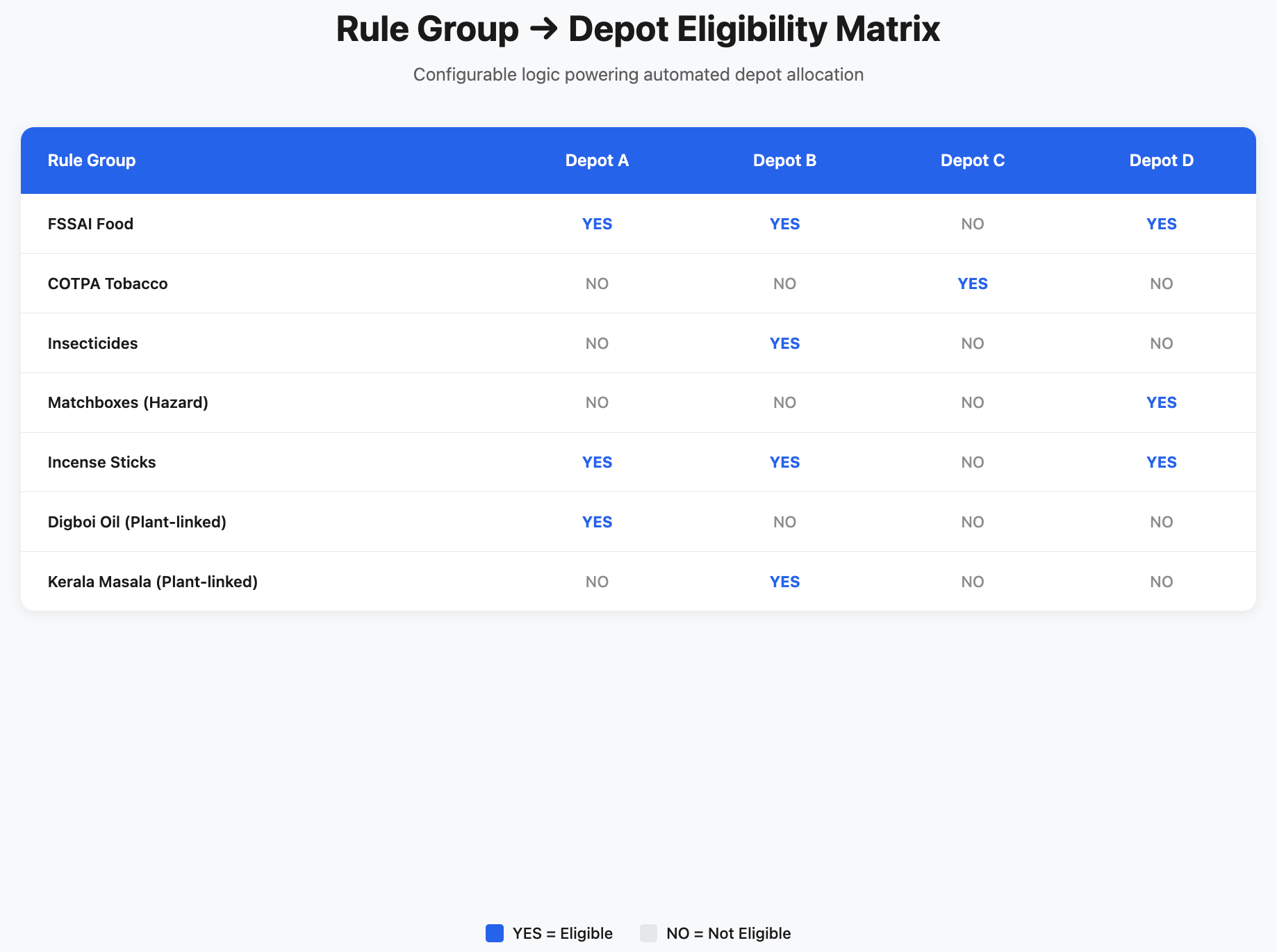
2) Translate compliance into execution: map rule groups to depot eligibility
Next, each depot is classified by what it can store. The case uses illustrative depot definitions such as:
-
Depot A : FSSAI compliant only
-
Depot B : FSSAI plus Insecticides Act
-
Depot C : COTPA compliant
-
Depot D : zone-specific, plant-linked only
This creates a living eligibility matrix. Instead of humans remembering which depot can handle what, the engine enforces it.
3) Remove a major source of errors: customer SKU mappings at PO receipt
Distributors often use their own SKU codes. JAVIS translates these into manufacturer codes at the moment the PO arrives, allowing the rule engine to run accurately without manual matching.
This is a subtle but critical improvement: if your inputs are inconsistent, even the best rule model breaks. Standardising at ingestion protects the entire flow.
4) Automate the actual decision moment: PO evaluation and depot split
When a PO arrives, JAVIS:
-
reads the Ship-To party
-
translates SKU codes
-
identifies each SKU’s division and rule group
-
applies depot eligibility
-
checks plant/zone constraints
-
determines which depot supplies which line item
This turns what used to be a judgment-heavy workflow into a deterministic, auditable decision process.
5) Convert decisions into execution: generate the correct number of sales orders
Where the old process required manual splitting into multiple internal sales orders
(often 3–6), the engine generates those sales orders automatically while keeping PO reference intact.
The post gives a concrete example: if a PO has 140 SKUs across six rule groups, JAVIS creates six internal sales orders automatically, unifying compliance, plant logic, and customer mapping in a single workflow.
The Impact
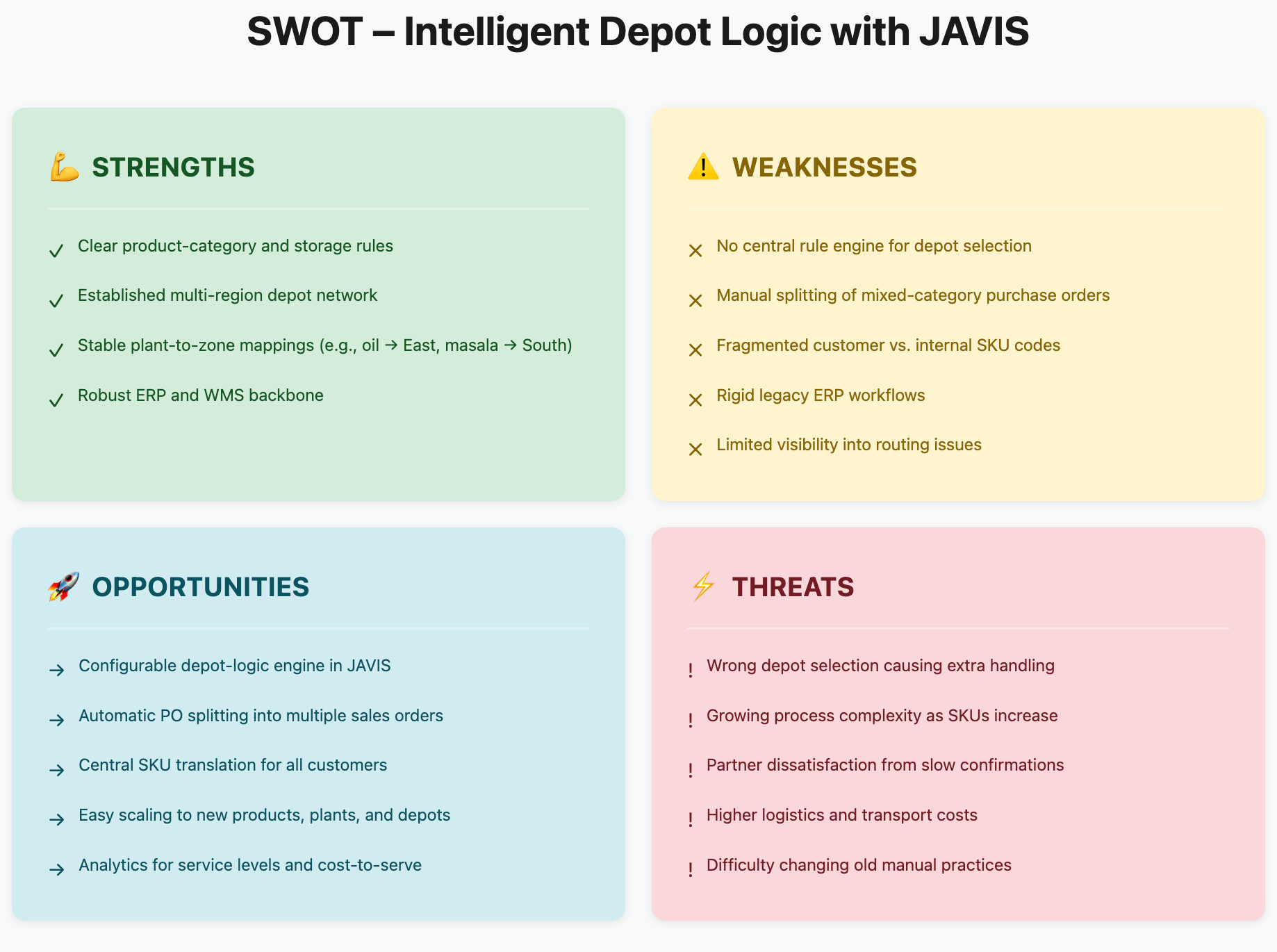
The client moved from a model where depot decisions lived in human interpretation to one where depot allocation became an O2C intelligence capability.
Outcomes reported in the case include:
-
Full compliance routing (rules enforced consistently across categories)
-
Faster order clearance (reduced time lost to manual routing and SO splitting)
-
A scalable foundation that can absorb new categories without increasing operational risk linearly
-
Reduced dependence on “tribal knowledge,” improving auditability and repeatability at catalogue scale
What supply chain CXOs can take away:
1) If rules vary by law, plant, or storage constraint, ERP alone won’t be the “brain”
The case makes a clear point: where product rules vary by regulation and network structure, the O2C layer must become the intelligence layer, not just a transaction recorder.
2) Treat depot allocation as a first-class decision system
Depot allocation isn’t “ops hygiene.” In regulated, multi-category FMCG, it’s a compliance and service-level decision that deserves explicit modelling.
3) Solve inputs first: SKU translation is not a clerical task
Automated customer-SKU → manufacturer-SKU mapping is foundational. Without it, decision logic becomes fragile and person-dependent.
4) Configuration beats custom code when the business will evolve
New categories, new depots, or changed licensing shouldn’t create a new IT project. The engine works because the rules live in configuration.