
-
For years, supply chains were designed around a simple assumption: efficiency would protect competitiveness. Fujitsu’s April 3, 2026 piece argues that this logic is now breaking down under what it calls an era of “permacrisis,” shaped by geopolitical instability, protectionism, and more frequent extreme-weather disruption. In that environment, a supply chain optimized only for lean flow and cost is increasingly exposed to shocks it was never built to absorb.
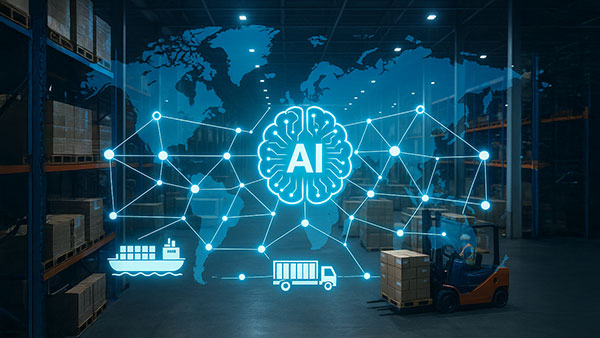
The article’s core argument is that traditional business-intelligence tools and backward-looking forecasting models are no longer sufficient on their own. What organizations need instead is the ability to rehearse future disruption before it happens. Fujitsu frames this as “digital rehearsal”: using a high-fidelity digital twin plus AI to test disruption scenarios, uncover causal relationships, forecast likely outcomes, and design response strategies in advance.
What makes this idea strategically interesting is the shift from prediction to preparation. Rather than asking only “What is likely to happen?”, digital rehearsal asks, “What happens if a major strait closes for three months, freight rates spike, port congestion spreads, and supplier options narrow at the same time?” Fujitsu says this approach works across three stages: risk scenario analysis, scenario forecasting, and strategy design.
The most useful part of the piece is its emphasis on causality. Fujitsu argues that conventional simulation and even generative AI often struggle to explain the intermediate links between an event and its downstream supply-chain effect. Its digital rehearsal model is designed to identify those chains explicitly, such as how conflict can trigger navigation risk, insurance increases, sanctions, vessel shortages, and then higher freight rates. That is a meaningful distinction, because resilience improves when companies understand not just the event, but the mechanism through which disruption spreads.
There is also a strong organizational point underneath the technology story. Fujitsu says one proof of concept accurately anticipated a rapid rise in freight rates across several scenarios, and the client highlighted a broader gain: moving from intuition-led analysis by individuals to a reproducible system that could be used more broadly across the organization. In other words, the value is not only better forecasting; it is making foresight more systematic and less dependent on a few experts.
This is still a vendor-led viewpoint, so it should be read with that in mind. But the underlying strategic signal is credible: the next supply-chain advantage may come less from having the most efficient network in normal conditions and more from having the best-prepared network when conditions stop being normal. That final sentence is my inference from Fujitsu’s argument about resilience-by-design and scenario rehearsal.
Why it matters:
The companies that outperform in the next phase may not be the ones that predict disruption perfectly. They may be the ones that rehearse enough futures in advance to respond with speed, clarity, and less value leakage when disruption arrives.